
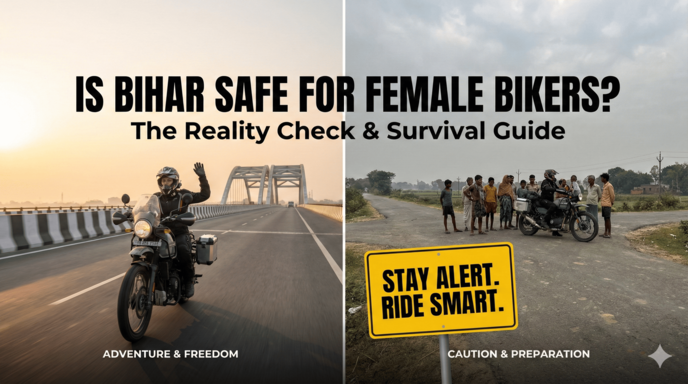
Planning a ride through East India? We ask the hard question: Is Bihar safe for female bikers in 2026? Read the honest reality check, safety protocols, route advice, and insights from the road.
Introduction: The Elephant on the Highway
Let’s rip the bandage off right at the start. When a female motorcyclist announces she is planning a solo trip to Ladakh or Goa, people cheer. When she says she is planning a ride through Bihar—perhaps en route to Nepal, Bhutan, or the Northeast—the reaction is very different.
“Are you mad?” “Don’t go alone.” “Isn’t that the ‘Jungle Raj’ state?”
For decades, Bihar has carried the heavy baggage of a negative stereotype. The cinema of the 90s painted a picture of lawlessness that has stuck in the minds of Indians outside the state. But as riders, we know that maps are not territories, and stereotypes are not ground realities.
It is 2026. The highways have changed. The digital infrastructure has changed. But has the mindset changed enough to call Bihar “safe” for a woman on two wheels?
At Nakli Life, we don’t believe in sugarcoating. If a road is broken, we tell you. If a route is unsafe, we warn you. This blog post is not a tourism brochure. It is a raw, honest, kilometer-by-kilometer assessment of what it means to be a female biker in Bihar today.
Is it safe? The answer is complex. It’s a mix of “Yes, much better than before” and “No, you cannot let your guard down for a second.”
In this comprehensive 2000-word guide, we break down the current reality, the actual threats versus the perceived ones, and the survival protocols you need to ride here with confidence.
The 2026 Landscape: What Has Changed?
Before we talk about safety, we must acknowledge the shift in infrastructure that impacts safety. If you ridden here 10 years ago, forget that experience.
1. The Highway Revolution
The biggest safety upgrade for any biker is good tarmac. Speed is safety. The ability to move quickly from point A to point B reduces exposure to risk. In 2026, Bihar’s primary artery, the East-West Corridor (NH-27) connecting Gopalganj to Muzaffarpur to Purnia, is world-class. You can cruise at 90-100 kmph. The connectivity to Patna via the new bridges (JP Setu, Gandhi Setu parallel lanes) means you don’t get stuck in bottleneck towns at slow speeds.
2. The Digital Safety Net
Ten years ago, a breakdown meant being stranded in a dead zone. Today, Jio and Airtel have near 100% 4G/5G coverage along major highways. GPS works. Digital payments (UPI) work at even small gumtis (stalls). This digital connectivity is a massive safety anchor for a solo female rider. You are never truly “off the grid” unless you choose to be in deep forested areas like Kaimur or Valmiki Nagar.
3. Increased Police Visibility (ERSS 112)
The Emergency Response Support System (Dial 112) is active in Bihar. Police patrolling on major highways has increased significantly, especially during the day. The visible presence of highway patrol cars acts as a deterrent.
The Real Threats vs. The Reel Threats
Most people fear dramatic, Bollywood-style crime—kidnapping or armed robbery. While not impossible anywhere in India, these are statistically rare for transiting travelers in 2026.
As a female biker, your actual challenges in Bihar will be far more mundane, annoying, and exhausting.
The #1 Threat: The “Gaze” (Gawking)
This is the hardest part of riding in Bihar. A woman on a motorcycle, fully geared up, is still an alien concept in rural areas. When you stop at a dhaba or a traffic signal, people will stare. It is not usually predatory; it is intense, unfiltered curiosity. Men, women, and children will surround your bike. They will ask questions: “Where are you from?” “Are you alone?” “How much does the bike cost?”
- The Danger: It can be overwhelming and intimidating. A crowd of 50 men staring at you can trigger panic.
- The Strategy: Keep your helmet ON at short stops. It acts as a shield. Be polite but firm. Answer briefly and move on. Do not engage in long conversations if you feel uncomfortable.
The #2 Threat: Aggressive Traffic Behaviour
Bihar’s traffic, especially local Boleros, Scorpios, and private buses, pays zero respect to two-wheelers. They expect you to move off the tarmac onto the dirt shoulder to let them pass. This aggression is gender-neutral—they do it to male bikers too—but as a female rider, if you crash or get into an altercation, you are more vulnerable.
The #3 Threat: The “Sunset” Zone
Bihar transforms after dark. The highways that feel safe at 2:00 PM feel menacing at 8:00 PM. The truck traffic becomes manic. The brightly lit dhabas give way to dark stretches. The local police presence thins out. The biggest threat at night is drunk driving (despite the liquor ban) and the sheer isolation in case of a mechanical failure.
The “Nakli Life” Female Safety Protocol
If you want to ride in Bihar, you need a protocol. We consulted experienced women riders who have traversed this region to create these non-negotiable rules.
Rule 1: The Sunrise-to-Sunset Mandate
Do not ride in Bihar after dark. Period. Plan your ride so that you are checked into your hotel by 5:30 PM or 6:00 PM at the latest. The risk-to-reward ratio just isn’t worth it. If you are delayed, stop at a major town (Muzaffarpur, Darbhanga, Begusarai) instead of pushing on to your destination in the dark.
Rule 2: The Art of Blending In (Gear vs. Attire)
This is controversial, but practical. While riding, wear full gear—jacket, pants, gloves, full-face helmet. This hides your gender identity from a distance. To a passing truck, you are just “a biker.” When off the bike, assess the location. In upscale Patna cafes, you can wear whatever you want. In a rural dhaba near Motihari, avoid clothes that attract too much attention. The goal is to minimize the “gaze.”
Rule 3: Strategic Stops Only
Do not stop at isolated tea stalls in the middle of nowhere. Plan your breaks at:
- Large, busy line hotels: Look for places with many family cars parked, not just trucks.
- Petrol Pumps (Company Owned): These are usually well-lit, have CCTV, and decent washrooms.
- Toll Plazas: They always have security personnel and activity.
Rule 4: The “Fake It ‘Til You Make It” Confidence
Predatory elements look for hesitation. Even if you are lost or nervous, do not show it. Walk with purpose. If you need to check directions, stop at a busy junction or ask a traffic policeman, not a random passerby on a lonely road. Your body language should say, “I know exactly what I am doing.”
Rule 5: The Digital Leash
- Live Location: Share your live WhatsApp/Google location with a trusted contact (family/friend) at all times.
- Offline Maps: Download Google Maps for the entire region. Network is good, but Murphy’s Law says it will fail when you need it most.
- Emergency Numbers: Save local police station numbers and the ERSS 112 on speed dial.
Inspiration: Female Motorcyclists Who Paved the Way
You are not the first. Many pioneering women have ridden across India, including through Bihar, proving it can be done.
While not exclusively “Bihar vloggers,” prominent figures like Vishakha and Candida Louis have done extensive cross-country rides that involve traversing the plains of North and East India. Their journeys show that with the right machine (often ADVs like the Himalayan or Dominar) and the right mindset, geography is not a barrier.
Furthermore, communities like The Bikerni (India’s first all-female motorcycle association) have chapters across India. While an active chapter in Bihar is still developing, riders from Bengal and Jharkhand chapters frequently ride through the state. Connecting with these communities online before your trip can provide recent, on-ground intel.
Seeing these women conquer similar terrain confirms one thing: The bike doesn’t know your gender. The road doesn’t care. It’s about your skill and your preparation.
Recommended Routes for Female Solo Riders
If you are doing Bihar for the first time solo, stick to these “Green Corridors.”
1. The Transit Route (Crossing to Siliguri/Northeast)
- Route: Gopalganj (UP Border) -> Muzaffarpur -> Darbhanga -> Araria -> Purnia -> Dalkhola (WB Border).
- Why it’s safer: This is almost entirely on the 4-lane East-West Corridor. High speed, high visibility, many petrol pumps, and bypasses most chaotic town centers. It’s boring, but safe.
2. The Tourist Route (Patna & History)
- Route: Patna -> Bakhtiyarpur -> Nalanda -> Rajgir.
- Why it’s safer: This is the tourist artery of Bihar. The roads are excellent, there is a lot of tourist police presence, and Rajgir is a very developed, family-friendly town with good hotels.
Routes to be Cautious About (Requires Experience):
- Patna to Valmiki Nagar (via Bettiah): The road construction near Bettiah is messy, dusty, and traffic is chaotic. Best done in a group.
- Kaimur Hills (Adhaura): While beautiful, it is isolated and has zero mobile network in parts. Do not do this solo on your first trip.
The Hygiene Challenge: Washrooms
Let’s be real—this is a major issue for female travelers in India, and Bihar is no exception. Clean, usable washrooms on the highway are rare.
- The Petrol Pump Hack: Only rely on large, new-looking petrol pumps (IndianOil/Reliance/Shell). Ask for the key to the ladies’ toilet.
- The Dhaba Reality: Most Dhaba toilets are unusable for women.
- The Strategy: Dehydrate slightly during the ride if you know a good stop is far away (not ideal for health, but practical). Plan your major washroom breaks at your hotel before starting and at major food plazas (like those on the Muzaffarpur highway). Carry toilet seat sanitizer sprays and tissues.
1. Safety Gear
- DOT/ECE Certified Full Face Helmet: Don’t compromise here. The highways are fast, and the hills are unpredictable.
- [ Amazon Link for Helmet https://amzn.to/4rcLvZI
- All-Season Riding Jacket with Armor: You need mesh for the Bihar heat, but a liner for when the altitude drops in Nepal.
- [Amazon Link for Riding Jacket Here] https://amzn.to/49ECdQf
- Riding Gloves (Touchscreen Compatible): Essential for navigation without taking gloves off.
- [ Amazon Link for Gloves Here] https://amzn.to/4sYTxqP
2. Bike Accessories & Tech
- Robust Mobile Holder with Charger: Navigation is crucial, and your battery will drain fast.
- [Amazon Link for Mobile Mount Here] https://amzn.to/3Zv61ZB
- Portable Tyre Inflator & Puncture Kit: You will find puncture shops, but being self-reliant on highway stretches is better.
- [ Amazon Link for Puncture Kit Here] https://amzn.to/4k4gEMK
- Bungee Cords/Rok Straps: To securely fasten your luggage to the tail seat.
- [Amazon Link for Luggage Straps Here] https://amzn.to/3LvOhdy
Conclusion: Should You Do It?
So, is Bihar safe for female bikers?
If “safe” means a manageable risk that can be mitigated with planning, awareness, and adhering to strict protocols, then yes, it is doable.
Riding in Bihar requires a higher state of alertness. It is demanding mentally. You have to constantly scan the traffic, manage the crowds at stops, and watch the clock to beat the sunset.
But the rewards are also real. The warmth of a village family offering you water, the stunning sunset over the Ganga, the thrill of riding on the smooth tarmac of the Kosi Mahasetu—these are experiences worth having.
Don’t let fear stop you, but don’t let ego blind you to reality. Prepare hard, ride smart, and trust your gut. If a situation feels wrong, throttle out.
Bihar is open for adventure. Just remember to keep your visor down and your spirits up.
Ride Safe. Live the Nakli Life.
Frequently Asked Questions (FAQs)
Q1: What is the best bike for a solo female rider in Bihar? A: Any bike you are comfortable handling in stop-and-go traffic. However, an ADV (like Himalayan 450, XPulse 200, or KTM Adventure) is best because they can handle sudden potholes and speedbreakers better, and the upright seating posture gives you a better view of traffic.
Q2: How do locals react to female bikers? A: 90% curiosity, 10% judgment. You will mostly encounter extreme surprise, followed by questions. In cities like Patna, people are more used to it. In villages, you are an event.
Q3: Is it better to ride solo or in a group? A: For your first time in Bihar, a group (mixed or all-female) is significantly safer and less stressful. The “power of numbers” reduces street harassment and gawking. If you must go solo, stick strictly to the national highways.
Q4: Are hotels safe for single women? A: Yes, in major towns. Stick to 3-star rated properties or well-reviewed business hotels in cities like Patna, Muzaffarpur, or Rajgir. Avoid cheap, seedy lodges near railway stations. Check reviews for “family-friendly” or “safe parking.”
Q5: What if I have a breakdown in a remote area? A: Do not try to fix it yourself on the roadside if it’s isolated. Call the RSA (Roadside Assistance) of your bike manufacturer immediately. Call 112. Try to move the bike to the nearest visible shop or settlement before waiting for help.
If you are a motorcycle enthusiast, please visit our post on visit to Darjeeling https://naklilife.com/patna-to-siliguri-by-road-on-motorcycle/