
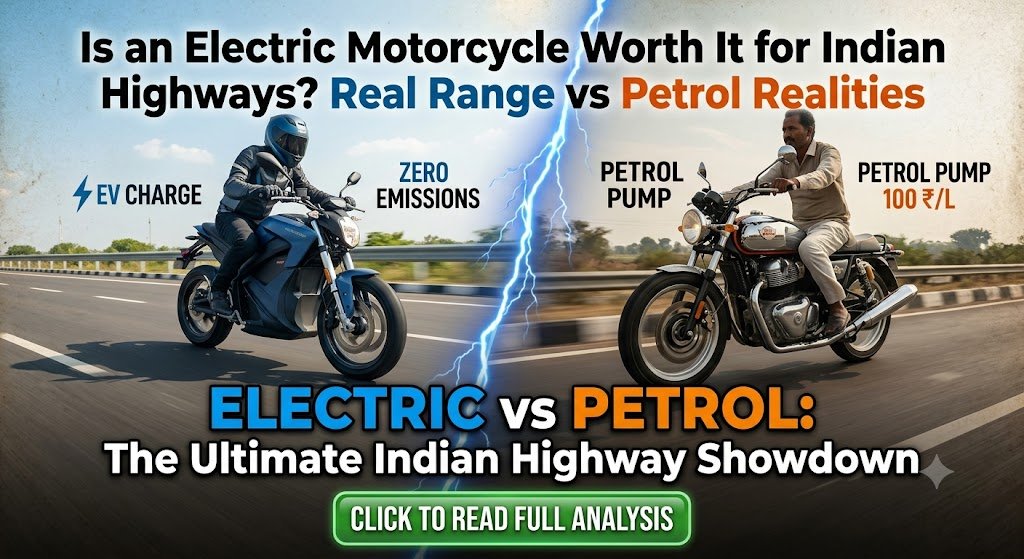
If you have spent any time scrolling through motorcycle forums, YouTube comments, or local riding groups lately, you’ve seen the debate raging: Is it finally time to ditch petrol for an electric motorcycle?
With high-capacity machines like the Ola Roadster Pro (boasting an 8–16 kWh battery pack), Ultraviolette F77 Recon, and Matter Aera making headlines, long-distance EV riding is no longer just a distant dream. On paper, specs promise 300+ km of range, lightning-quick acceleration, and zero trip expenses compared to standard ₹100/liter petrol running costs.
But as any experienced rider knows, on-paper claims rarely survive the real Indian highway.
Between sudden thermal throttling, high-speed range drop-offs, and unpredictable highway chargers, long-distance EV touring comes with a unique set of challenges. Is an electric bike truly ready to take on long highway stretches in 2026, or are petrol bikes still the undisputed champions of the open road?
Let’s break down the hard facts, the real-world battery mathematics, and the actual state of Indian highway charging infrastructure.
The 2026 Reality: Indian Highways vs. Battery Dynamics
Riding an electric motorcycle around city streets is effortless. Stop-and-go traffic plays right into an electric motor’s strengths—regenerative braking constantly tops up your charge, lower speeds draw minimal power, and thermal management is rarely pushed to its limit.
The moment you hit the open highway, however, the entire equation flips.
1. The High-Speed “Wind Resistance tax”
Internal combustion engine (ICE) petrol bikes are actually more fuel-efficient at cruising speeds (around 70–80 km/h in top gear) than they are idling in bumper-to-bumper city traffic.
Electric bikes work in complete reverse:
- Aerodynamic drag: Wind resistance increases exponentially with speed ($F_d \propto v^2$). Because EV motors lack multi-speed gearboxes (with rare exceptions like the Matter Aera), maintaining 90–100 km/h requires sustained high current from the battery pack.
- The “IDC vs. Real World” Trap: A motorcycle advertised with an IDC (Indian Driving Cycle) range of 300 km will typically deliver roughly 160–180 km when cruising continuously at triple-digit speeds.
2. Thermal Throttling in Indian Heat
Indian summer ambient temperatures easily cross 40°C on open highways. Lithium-ion batteries (especially 21700 cell formats) generate significant heat under continuous high-power discharge. Once the Battery Management System (BMS) detects overheating, it automatically throttles power to preserve battery health, dropping your top speed from 110 km/h to 60 km/h mid-ride.
Real-World Highway Range Comparison: Expectation vs. Reality
Here is how today’s leading electric motorcycles perform when taken out of the lab and onto actual Indian highways:
| Electric Bike Model | Battery Capacity | Claimed Range (IDC) | Real Highway Range (80–100 km/h) | Real Highway Efficiency |
| Ola Roadster Pro | 16 kWh | Up to 579 km | ~310–350 km | Best in class capacity; heavy payload. |
| Ultraviolette F77 Recon | 10.3 kWh | 323 km | ~180–210 km | Highly stable frame; predictable power delivery. |
| Matter Aera 5000+ | 5 kWh | 172 km | ~100–110 km | A 4-speed manual gearbox helps efficiency, but small pack. |
| Komaki Ranger | 4.4 kWh | 250 km | ~120–135 km | Cruiser ergonomics; speed capped at ~80 km/h. |
Key Takeaway: Always subtract 35% to 45% from any manufacturer’s claimed IDC range to estimate your safe cruising buffer between highway charging stops.
The Charging Infrastructure Breakdown
Range is only half of the highway story; the real stress point for long-distance EV riding is the charging stop.
The Good: Expanding Highway Networks
India’s public charging grid has expanded significantly. Major corridors like Delhi–Jaipur, Mumbai–Pune, Bengaluru–Chennai, and Patna–Kolkata now have DC fast-charging setups at regular intervals along major food hubs and fuel stations.
The Bad: Scooter Connectors vs. Car Chargers
Here is the biggest headache for electric bike riders on Indian highways:
- The Connector Problem: Most public highway charging hubs feature CCS2 (Combined Charging System 2) plugs designed specifically for electric passenger cars (like Nexon EV or MG ZS EV).
- Adapter Gaps: Most electric two-wheelers rely on proprietary AC slow plugs or specific portable chargers unless equipped with high-voltage architectures (such as Raptee’s CCS2 native port). If your bike only accepts standard AC charging, your “quick stop” could turn into a 4-to-6-hour wait at a highway dhaba.
Highway Travel Reality Checklist:
[ ] Does your e-bike support CCS2 public DC Fast Charging?
[ ] Have you installed 3-4 separate charging apps (Statiq, Tata Power, ChargeZone)?
[ ] Is there a backup charging station within a 20 km radius of your planned stop?
Financial Mathematics: Petrol vs. Electric (5-Year Ownership)
Is the high upfront cost of an electric motorcycle justified by fuel savings on long rides? Let’s compare a 350cc Petrol Tourer (e.g., Royal Enfield Hunter/Classic 350) against a Performance Electric Bike (e.g., Ultraviolette F77/Ola Roadster Pro) over a distance of 50,000 km.
Petrol Bike Cost Breakdown:
- Initial On-Road Cost: ~₹2.30 Lakh
- Fuel Efficiency: 32 km/L
- Total Fuel Needed: ~1,562 Liters
- Total Fuel Cost (@ ₹105/L): ₹164,000
- Routine Maintenance (10 Services + Oil/Filters): ~₹35,000
- Total 50,000 km Cost:~₹429,000
Electric Motorcycle Cost Breakdown:
- Initial On-Road Cost:~₹3.30 Lakh
- Electricity Consumption: ~3.5 kWh per 100 km (~1,750 kWh total)
- Total Energy Cost (@ ₹9/unit avg): ₹15,750
- Public Fast Charging Premium (20% highway usage): ~₹8,000
- Routine Maintenance (Brakes, Tires, Belt/Chain adjustment): ~₹12,000
- Total 50,000 km Cost:~₹3,65,750
The Verdict on Financials: You save roughly ₹60,000 to ₹70,000 net over 50,000 km, despite paying a much higher upfront purchase price. However, if you ride fewer than 500 km per month, it will take over 6 years just to break even on the initial purchase difference.
Pros and Cons of Electric Highway Riding
The Pros
- Instant Overtaking Power: Massive low-end torque ($100+\text{ Nm}$ instantly) makes overtaking long trucks on two-lane highways effortless without downshifting.
- Zero Engine Vibration: Smooth, whisper-quiet operation significantly reduces rider fatigue on long stretches.
- Integrated Tech & Safety: Modern e-bikes come packed with turn-by-turn navigation, geofencing, regenerative braking modes, and even rear-facing blind-spot radar.
The Cons
- Forced Route Rigidity: You cannot explore remote off-grid routes or detour into interior state highways without planning every single watt-hour.
- Depreciation & Battery Replacement: A replacement 10+ kWh battery pack out-of-warranty can cost 30–40% of the entire motorcycle’s value.
- Weight Penalties: Long-range battery packs make electric tourers heavy (often 200 kg+), making low-speed maneuvering in tricky terrain cumbersome.
Final Verdict: Should You Buy an Electric Bike for Highways?
YES, Buy an electric motorcycle if:
- Your primary highway trips are predictable intercity routes (e.g., covering 150–250 km between major urban hubs with proven fast-charging corridors).
- You enjoy a relaxed touring pace where taking a 45-minute coffee break every 180 km aligns naturally with your riding style.
- You want a single machine that acts as an ultra-cheap daily commuter during the week and a high-tech highway machine on weekends.
NO, stick to Petrol for Now if:
- You love unplanned, spontaneous road trips into remote hill stations, interior forest tracks, or sparse border regions where power grids are unreliable.
- You prefer iron-butt riding—covering 600–800 km in a single day with only 5-minute fuel stops.
- You don’t have a dedicated ground-floor parking spot with a reliable charging socket at home.
Electric motorcycles have officially crossed the threshold from “novelty city toys” to legitimate short-haul highway machines. While they won’t fully replace the raw, go-anywhere freedom of a petrol adventure bike just yet, riders who plan their routes smart will find that the electric highway experience is quieter, faster, and surprisingly practical.
Essential Gear List (Affiliate Ready)
1. Safety Gear
- DOT/ECE Certified Full Face Helmet: Don’t compromise here. The highways are fast, and the hills are unpredictable.
- [ Amazon Link for Helmet https://amzn.to/4rcLvZI
- All-Season Riding Jacket with Armor: You need mesh for the Bihar heat, but a liner for when the altitude drops in Nepal.
- [Amazon Link for Riding Jacket Here] https://amzn.to/49ECdQf
- Riding Gloves (Touchscreen Compatible): Essential for navigation without taking gloves off.
- [ Amazon Link for Gloves Here] https://amzn.to/4sYTxqP
2. Bike Accessories & Tech
- Robust Mobile Holder with Charger: Navigation is crucial, and your battery will drain fast.
- [Amazon Link for Mobile Mount Here] https://amzn.to/3Zv61ZB
- Portable Tyre Inflator & Puncture Kit: You will find puncture shops, but being self-reliant on highway stretches is better.
- [ Amazon Link for Puncture Kit Here] https://amzn.to/4k4gEMK
- Bungee Cords/Rok Straps: To securely fasten your luggage to the tail seat.
- [Amazon Link for Luggage Straps Here] https://amzn.to/3LvOhdy
My Amazon store link: https://amzn.in/d/0j5opklt
Frequently Asked Questions (FAQs)
1. What is the real-world highway range of electric motorcycles compared to claimed range?
Manufacturers test electric vehicles using the Indian Driving Cycle (IDC), which assumes lower speeds and frequent stopping.On open highways at sustained speeds of 80–100 km/h, aerodynamic drag drastically increases energy consumption.Expect a real-world range reduction of 35% to 45% from the official claimed IDC range.
2. Can I use electric car DC fast chargers to charge an electric motorcycle on the highway?
Only if your motorcycle features a compatible charging inlet. Most high-capacity electric cars in India use the CCS2 (Combined Charging System 2) standard.While most electric scooters and lightweight e-bikes use proprietary AC plugs, newer premium motorcycles are coming equipped with native CCS2 ports or dedicated manufacturer fast-charging networks.Always verify your bike’s port compatibility before planning a trip.
3. How long does a highway fast-charging stop take for an electric bike?
DC fast chargers can typically top up an electric motorcycle’s battery from 20% to 80% in about 45 to 90 minutes.However, the charging speed slows down noticeably after 80% to protect the battery from overheating and cell degradation.
4. Does extreme summer heat affect electric motorcycle battery performance on highways?
Yes. Ambient temperatures exceeding 40°C combined with continuous high-speed discharge build significant heat within the battery pack.The motorcycle’s Battery Management System (BMS) will trigger thermal throttling, automatically reducing motor power and top speed until the battery cools down safely.
5. How much does it cost to fully charge a long-range electric motorcycle at home vs. highway public chargers?
Charging at home costs approximately ₹8 to ₹10 per kWh, making a full 10 kWh battery charge cost around ₹80 to ₹100. Commercial public fast chargers on highways charge a premium, typically costing between ₹18 and ₹25 per kWh, bringing a full fast-charge to roughly ₹180 to ₹250.
6. Is it safe to charge an electric motorcycle at a road-side dhaba using standard outlets?
Yes, provided you use an authentic portable charger connected to a properly earthed 15A high-power socket.Avoid cheap extension cords, and never plug into ungrounded 6A sockets, as voltage fluctuations and lack of earthing can damage the charger or trip circuit breakers.
7. How does riding with a pillion and luggage affect highway battery range?
Carrying extra payload adds mass, increasing rolling resistance and the energy required during acceleration and climbing.Expect an additional 10% to 15% drop in total range when traveling fully loaded with a pillion rider and heavy saddlebags.
8. How long do electric motorcycle batteries last before needing replacement?
Modern lithium-ion battery packs in performance electric bikes last between 1,500 to 2,000 full charge-discharge cycles.Premium manufacturers offer extensive warranties—some covering up to 8 years or 8,00,000 km. For average riders, the battery pack will easily last 7 to 10 years before capacity degrades below 70-80%.
9. Why don’t electric motorcycles have multi-speed transmission gearboxes like petrol bikes?
Electric motors deliver 100% of their maximum torque instantly from zero RPM across a very wide RPM band, eliminating the operational need for traditional multi-speed gearboxes. While some bikes incorporate multi-speed setups for efficiency gains, direct-drive single-speed transmission remains the standard to reduce mechanical weight, complexity, and maintenance.
10. What apps should I download before planning an electric bike highway trip in India?
Before embarking on a highway tour, install key Indian charging network apps such as Tata Power EZ Charge, Statiq, ChargeZone, PlugShare (to check live station status and user reviews), and your bike manufacturer’s companion application.