
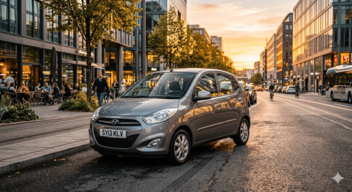
The year is 2026, and the automotive market is, quite frankly, overwhelming. With new car prices continuously climbing, soaring taxes, and the industry aggressively pushing bulky, expensive SUVs, the common buyer is left in a tough spot. If you are looking for a reliable daily driver that doesn’t force you to break the bank, you might be looking in the wrong direction by only browsing showrooms.
Sometimes, the best decisions are the ones hiding in plain sight in the second-hand market. Today, we are talking about a true legend of the Indian roads: the Hyundai i10 (and its evolutionary sibling, the Grand i10).
Even in 2026, purchasing a used Hyundai i10 is not just a compromise; it is an absolute boss move. Whether you are navigating tight, chaotic streets, running daily errands, or need a dependable secondary vehicle, here is an in-depth breakdown of why an old i10 remains an unbeatable purchase this year
Table of Contents
Unbeatable Financial Prudence and Depreciation Advantage
The moment you drive a brand-new car off the dealership lot, it loses a massive chunk of its value. This phenomenon, known as the depreciation curve, is the new car buyer’s worst enemy but the used car buyer’s best friend.
By 2026, models from 2017 to 2021 (the golden era of the Grand i10 and early Nios) have completely absorbed their steepest depreciation hits. While a brand-new top-tier hatchback today will easily cost you upwards of ₹8 to ₹10 lakhs on-road, a brilliantly maintained, top-spec used Hyundai i10 Asta or Sportz can be acquired for a fraction of that price—often sitting comfortably in the ₹3.5 Lakh to ₹5 Lakh bracket.
Why is this so crucial in 2026? Because the cost of borrowing (car loans) and insurance premiums are directly tied to the car’s valuation. When you buy a used i10, you are drastically reducing your loan burden, your monthly EMIs, and your annual comprehensive insurance costs. You are essentially getting 80% of the utility of a brand-new car for roughly 40% of the price. For anyone looking to maintain financial freedom while enjoying private mobility, the math is undeniable
The Legendary 1.2L Kappa Engine: Refinement Above All
Let’s talk about what is under the hood. The modern budget car market is currently flooded with 3-cylinder engines. While manufacturers claim these are highly efficient, anyone who loves driving will tell you the truth: 3-cylinder engines are inherently unbalanced. They vibrate at idle, they sound harsh under acceleration, and they often lack low-end punch.
Enter the Hyundai i10’s legendary 1.2-litre, 4-cylinder Kappa VTVT petrol engine.
Even by 2026 standards, this engine remains a masterclass in refinement. Start a well-maintained used i10, and you can barely hear the engine idling from inside the cabin. The power delivery is buttery smooth, offering a linear acceleration curve that makes darting through city traffic an absolute breeze.
Producing around 82 bhp and 114 Nm of torque, it isn’t a race car, but it possesses the perfect power-to-weight ratio for urban environments. It never feels underpowered with the AC on full blast, and the clutch action is notoriously light. For those who spend hours stuck in stop-and-go bumper-to-bumper traffic, this refined 4-cylinder engine prevents the driving fatigue that comes with vibrating, noisy budget cars.
Premium Interiors That Actually Age Well
One of the biggest complaints about buying older used cars is that the interiors often feel dated, cheap, or worn out. Hyundai has always been lightyears ahead of its competition when it comes to cabin quality.
When you sit inside a 2018 or 2019 Grand i10 today, it does not feel like a “cheap old car.” Hyundai’s use of high-quality, soft-touch plastics, well-damped buttons, and excellent fit-and-finish means that these cabins age remarkably well. Unlike competitors where dashboards start rattling after 40,000 kilometers, the i10’s cabin remains solid, quiet, and insulated from outside noise.
Furthermore, Hyundai was incredibly generous with features. If you manage to find a used Sportz or Asta variant, you will likely get features that are still considered premium in 2026:
- Rear AC Vents: An absolute blessing during brutal Indian summers.
- Steering-Mounted Controls: For easy audio and call management.
- Cooled Glovebox: Perfect for keeping your water bottles chilled on long summer drives.
- Electrically Adjustable & Foldable ORVMs: Convenient for squeezing into tight parking spaces.
These features ensure that even though your car is a few years old, your daily driving experience feels thoroughly modern.
The Ultimate City Commuter and Parking Champion
Let’s face the reality of driving in 2026. Urban infrastructure is stretched to its limits. Whether you are navigating the dense, chaotic intersections of a growing metropolis or trying to find a parking spot in a crowded local market, large cars are becoming a massive liability.
The Hyundai i10 is the ultimate antidote to city congestion. It features compact external dimensions that allow you to squeeze through narrow lanes that would make an SUV owner sweat. But the real magic lies in its turning radius. With a turning radius of roughly 4.7 meters, executing U-turns in tight alleys or parallel parking in minimal spaces becomes a stress-free affair.
Despite its compact exterior, Hyundai’s engineers worked magic on the interior packaging. The “Tall Boy” design heritage of the original i10 means there is ample headroom, and the window lines are large, providing excellent all-around visibility. This lack of blind spots is a huge confidence booster for new drivers or those transitioning to a second-hand vehicle.
Rock-Bottom Maintenance and Abundant Spare Parts
When buying a used car, the biggest fear is the dreaded mechanic’s bill. “What if it breaks down? Will the parts be expensive?”
With the Hyundai i10, you can put those fears to rest. Over the last decade and a half, Hyundai has established the second-largest service network in the country. Even if you are far from a major metro city, finding a certified service center or a reliable local mechanic who knows the i10 inside out is incredibly easy.
More importantly, genuine spare parts (Hyundai Mobis) are ubiquitous and highly affordable. Because the i10 platform was sold in such massive numbers, parts manufacturers continue to produce everything from bumpers and headlights to clutch plates and brake pads in high volume.
- A routine service for an i10 (oil change, filters, general checkup) rarely exceeds ₹4,000 to ₹5,000.
- Wear-and-tear parts are cheap to replace, meaning you can maintain the car in top-tier condition without the financial anxiety associated with maintaining premium sedans or compact SUVs.
Flexibility: CNG Compatibility and Modification Potential
With fluctuating fuel prices in 2026, running costs are a major concern. The 1.2L Kappa engine is notoriously friendly with aftermarket Sequential CNG kits. If you purchase a pure petrol used i10, retrofitting a high-quality CNG kit is a seamless process. Alternatively, you can easily find factory-fitted CNG models in the used market. Once on CNG, the running cost of an i10 plummets to roughly ₹3.50 per kilometer, making it cheaper to run than a modern premium motorcycle!
Additionally, for the younger demographic or content creators (like us here at NakliLife!), the i10 is a brilliant blank canvas. It is incredibly modification-friendly. Whether you want to slap on a set of aggressive aftermarket alloy wheels, upgrade the lighting setup to custom LEDs, or wrap the roof in gloss black, the i10’s timeless design responds beautifully to aesthetic upgrades.
High Resale Demand: Your Money is Safe
Finally, buying a used i10 is a highly liquid investment. Suppose you buy a 2019 model today in 2026, use it rigorously for three years to learn driving or commute to work, and then decide to upgrade to an EV or a larger vehicle in 2029.
Because the i10 badge holds immense trust in the Indian market, you will easily find a buyer. Unlike obscure brands or discontinued experimental models that suffer from “dead resale,” the i10 is always in demand by first-time car buyers, college students, and families looking for a secondary car. You will be able to recover a very respectable portion of your initial investment.
Essential Checklist: What to Look for When Buying a Used i10 in 2026
If you are convinced that a second-hand i10 is your next move, do not just buy the first one you see. Keep this quick NakliLife checklist in mind during your test drive:
- Steering Rattle: On older Grand i10s, the steering column bush can sometimes wear out, causing a slight rattling sound when driving over rough, broken roads. It’s a cheap fix, but a good point to negotiate the price down.
- Clutch Hardness: While the i10 clutch is naturally light, a heavy or jerky clutch pedal indicates the clutch plate is nearing the end of its life (usually around the 60,000 km mark).
- AC Cooling Coil: Check if the AC chills the cabin quickly. A weak AC might just need a gas top-up, but it could also point to a clogged cooling coil, which requires dashboard removal to fix.
- Service Records: Always prioritize cars that have complete service history records. A vehicle driven 80,000 km with timely oil changes is always a better buy than a vehicle driven 30,000 km that has been neglected.
- Rust Checking: Carefully inspect the lower edges of the doors, the boot lid, and the area around the battery terminal for any signs of rust.
Final Verdict from NakliLife
At NakliLife.com, we are all about cutting through the noise and finding genuine value. In a world obsessed with showing off massive, over-financed SUVs, picking up a well-maintained, pre-owned Hyundai i10 is a statement of practicality, financial intelligence, and driving peace of mind.
It handles city chaos effortlessly, pampers you with a silent cabin, and asks for very little in return regarding maintenance. If you are hunting for the perfect used car in 2026, the Hyundai i10 shouldn’t just be on your list—it should probably be at the very top.
What do you think? Are you considering buying a second-hand car this year? Let us know your thoughts in the comments below, and don’t forget to share this guide with anyone looking to buy a reliable used car in 2026!
Please read our other interesting posts
https://naklilife.com/patna-to-bodh-gaya-bike-trip/
https://naklilife.com/never-guess-your-tire-pressure-again-skyshop-c260-solar-tpms-review/: 7 Undeniable Reasons to Buy a Used Hyundai i10 in 2026: The Ultimate Smart Buyer’s Guide